Best Ring Lights for Content Creators (2026)
Five ring lights UGC creators actually use — honest picks by size, budget, and use case so you can buy once and shoot confidently.
Maya Rivera
June 30, 2026 · 9 min read
The short answer
For most beginner UGC creators, a 10–12" LED ring light kit with a phone holder and adjustable stand covers 90% of indoor shoots. Step up to an 18" only if you want a larger catch-light on a dedicated desk or studio setup.
Your lighting matters more than your camera.
I know that sounds backward — but when I look at the UGC clips brands approve versus the ones they pass on, the difference is almost never camera quality. It’s light. Clean, even, flattering light that makes your face look like it belongs in an ad, not a FaceTime call.
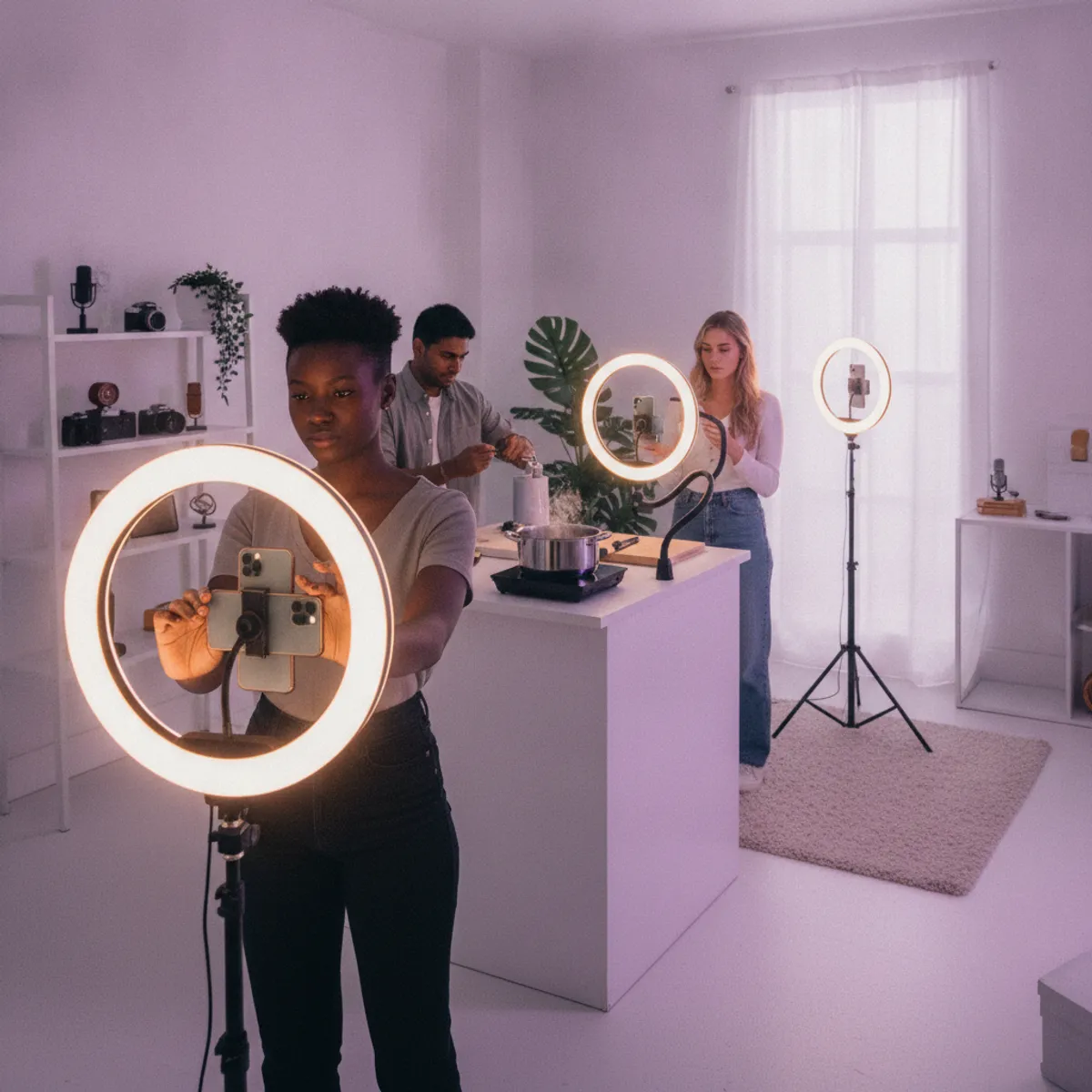
A ring light is the fastest way to get there when you’re shooting solo. It sits in front of you, wraps light evenly around your face, and puts that small circular catch-light in your eyes that signals professional before you’ve said a word.
This guide covers the five ring lights worth considering in 2026 — specific products, honest pros and cons, and a clear recommendation for who each one is for. I’ll also cover when to skip the ring entirely and go straight to a key light.
What actually matters when buying a ring light
Before we get into picks, three specs actually move the needle at this price tier:
Size (diameter). Bigger rings cast softer, more flattering light with a larger catch-light. A 10” ring handles phone selfie-style shooting well. Go 14–18” if you shoot at arm’s length, use a webcam, or want that full studio look.
Color temperature range. Look for adjustable warm-to-cool (roughly 3000–6000K). Being able to match the ambient light in your room — whether you have warm bulb fixtures or cool daylight windows — makes your footage look consistent without heavy color grading.
What comes in the kit. Most beginner ring lights are sold as kits with a floor stand, phone holder, and remote. Check the bundle matches your setup before buying: a compact clip-style ring might be all you need if you already have a tripod; a full kit makes more sense if you’re starting from zero.
The best ring lights for content creators
1. Best overall — Neewer 18” LED Ring Light Kit
Check the current price on Amazon →
Who it’s for: Creators who want the classic full-face ring-light look and have a dedicated shooting spot.
The Neewer 18” has become the default recommendation for a reason: it is consistently reliable, produces genuinely flattering light, and the kit includes everything you need to start shooting — tall floor stand, ball-head phone mount, and carry bag. The 18” diameter wraps light around the face with a wide, even spread. Color temperature adjusts from warm (~3200K) to cool (~5500K), and brightness goes from dim accent to powerfully bright.
Pros:
- Wide, flattering catch-light that looks polished on camera
- Full color-temp range handles different ambient light conditions
- Stable floor stand holds position through a full shoot
- Dual-colored LED rings mean no color gels needed for warm or cool output
Cons:
- Takes up real floor space — challenging in small apartments
- Slower to set up and break down than desk-mount options
- The included phone mount can wobble at max extension; adding a clip-on phone clamp fixes this for a few dollars
Best for: Dedicated shooting spaces, waist-up or full-face frames, creators who want the classic “YouTube studio” aesthetic.
2. Best budget / beginner pick — UBeesize 10” Selfie Ring Light with Tripod
Check the current price on Amazon →
Who it’s for: Creators just getting started who need an affordable all-in-one kit under $50.
The UBeesize 10” packs a ring light, a collapsible tripod that extends to head height, a phone holder, and a Bluetooth remote into one kit. Three color modes (warm, cool, daylight) and ten brightness levels give you enough range for most indoor conditions. The Bluetooth remote is genuinely useful — it lets you trigger recording on your phone without sprinting back to hit the button.
Pros:
- Affordable; often bundled with a clip-on phone holder and remote
- Portable and lightweight — fits in a backpack for on-location shoots
- Bluetooth remote enables hands-free recording start/stop
- Phone holder fits most current phone sizes
Cons:
- 10” diameter means a tighter, smaller catch-light — less dramatic at distance
- Lower maximum brightness than larger kits; works best as the primary light in dim rooms
- Stand can feel slightly wobbly on uneven floors; a sandbag or weight on the base helps
Best for: First-time UGC creators, bedroom setups, anyone who wants to start shooting today without spending much.
3. Best desk setup — Elgato Ring Light
Check the current price on Amazon →
Who it’s for: Creators who shoot at a fixed desk and want professional quality without floor-stand clutter.
The Elgato Ring Light solves the apartment problem by clamping to a desk edge or monitor arm instead of eating floor space. It is app-controlled via Elgato’s Control Center software — you can save color temperature and brightness presets and recall them instantly, which matters when you shoot UGC for multiple brands with different aesthetic expectations. The diffusion panel keeps output soft even at high brightness, and the build quality is noticeably more solid than budget options.
Pros:
- No floor footprint — mounts to desk or existing monitor arm
- App and hardware-button control; preset-driven workflow
- Excellent soft diffusion with minimal harsh hotspot
- Wide color temperature range (approximately 2900–7000K)
Cons:
- Premium price point — roughly three to four times the cost of a budget kit
- Clamp requires a sturdy desk edge; not all setups work
- 12” diameter is tighter than an 18” floor ring for full-face frames
Best for: Creators with permanent desk setups, multi-brand workflows, or those already using Elgato’s streaming ecosystem.
4. Best for close-up and product shots — Neewer 10” LED Ring Light Kit (desktop)
Check the current price on Amazon →
Who it’s for: Creators who shoot close-up product demos, beauty content, or hands-in-frame reviews.
The Neewer 10” desktop version sits on a compact arm stand at table height, making it purpose-built for tight shots — think skincare demo, unboxing, or a product flat-lay with your hands in frame. The smaller diameter creates a focused, even light on subjects within arm’s reach without spilling light across the room. The same Neewer build quality as the 18”, just scaled down and priced accordingly.
Pros:
- Compact and easy to store when not in use
- Even, focused light ideal for product and detail shots
- More affordable than full-size kits
- Desktop arm keeps it positioned without a floor stand
Cons:
- Not suitable for waist-up or full standing shots — too small
- Lower maximum brightness than larger rigs
Best for: Product review UGC, beauty tutorials, tabletop content.
5. Best portable — Joby Beamo Ring Light
Check the current price on Amazon →
Who it’s for: Creators who shoot on location and need a ring light that fits in a camera bag.
The Joby Beamo is genuinely pocket-sized, USB-C powered, and attaches directly to Joby’s GorillaPod tripods via a standard cold shoe mount. A magnetic diffuser removes in seconds for a harder, more directional look. Because it runs from any USB-C power bank, you’re not hunting for outlets at a coffee shop, a product shoot, or a client’s location.
Pros:
- Truly portable — fits in a jacket pocket or camera bag
- USB-C powered; runs off any power bank
- Magnetic diffuser swaps quickly for different light quality
- Compatible with GorillaPod and any cold shoe mount
Cons:
- Small diameter means a smaller, tighter catch-light
- Lower maximum output — works best as a fill or supplement to natural light, not the sole light source in a dark room
- Best paired with another light source for indoor evening shoots
Best for: On-location shoots, outdoor UGC, creators who already own GorillaPod gear.
Ring light vs. key light: which one is right for you?
Ring lights produce symmetrical, even light with that recognizable circular catch-light in the eyes. They are fast to set up, forgiving to use, and flattering on most faces for talking-head content. For standard UGC — you facing the camera and speaking naturally — they are the obvious starting point.
Key lights (softboxes, LED panels) produce directional light that looks more cinematic and natural. They create depth, a slight shadow on one side of the face, and a less “YouTube studio” feel. They work better for lifestyle content, over-the-shoulder frames, and brand work where the client wants something that feels less overtly lit.
If you’re just starting out: buy the ring light. If you’re shooting consistently, booking clients, and want your clips to look more editorial, consider adding a key light as a complement. Our UGC creator starter kit guide covers the full gear picture once you’re ready to build out your setup beyond lighting alone.
Four setup habits that make any ring light work better
1. Position at eye level, angled slightly down. Too low and you get unflattering shadows under the eyes; too high and the catch-light moves out of the visible eye area.
2. Match your room’s ambient color temperature. If your space has warm tungsten bulbs, dial the ring toward warm. A mismatched ring creates an unnatural color cast on skin that is difficult to fix in post.
3. Shoot toward a neutral wall, not a window. Bright natural light behind you will overpower your ring light and silhouette your face — especially in late afternoon.
4. Check the catch-light before recording. It should appear in the upper-center of each eye. If it’s clipped, off-center, or missing, reposition your face or the ring rather than adjusting exposure settings.
For camera recommendations that pair well with your new lighting setup, see our guide to the best cameras for UGC creators.
The bottom line
For most creators starting out, a 10–12” ring light kit under $50 is the practical buy: easy to set up, portable enough for different locations, and genuinely capable enough to book your first clients. The Neewer 18” is the step-up pick if you have the space and want a larger, more polished catch-light. The Elgato Ring Light earns its higher price if you’re shooting at a fixed desk and want preset-driven control that speeds up your workflow across multiple brands.
Buy the one that fits your space, set it up today, and start shooting. The best ring light is the one you’ll actually use.
Frequently asked questions
What size ring light is best for UGC content?
For close-up phone videos, a 10–12" ring light is plenty. If you're shooting at arm's length or further, go 14–18". Bigger rings give a larger, more flattering catch-light but cost more and take up more space.
Do I need a ring light or a key light for UGC?
Ring lights are faster to set up and give a symmetrical, even look — great for talking-head UGC. Key lights (softboxes, LED panels) look more cinematic and natural. Start with a ring light; upgrade to a key light once you're booking consistent clients.
Can I use a ring light with a regular camera instead of a phone?
Yes. Most ring lights include a universal phone holder, but a standard camera can sit on a tripod behind the ring. Just make sure the ring is large enough that the lens shoots through the center without barrel distortion.
How much should I spend on a ring light as a beginner?
A reliable kit in the $30–60 range covers everything a new UGC creator needs. Reserve the premium options for when you're shooting daily or need app-controlled color temperature for consistent brand work.
Maya Rivera
UGC Creator & Editor-in-Chief
Maya makes short-form ads for DTC beauty and wellness brands and writes the playbooks she wishes she'd had on day one.
3+ years creating UGC for 40+ brands; built a UGC business to full-time income before turning 24.
Steal the UGC playbook
One email a week: a pitch template, a gear pick, and the trend that's actually moving brand budgets. Free.
No spam. Unsubscribe anytime.